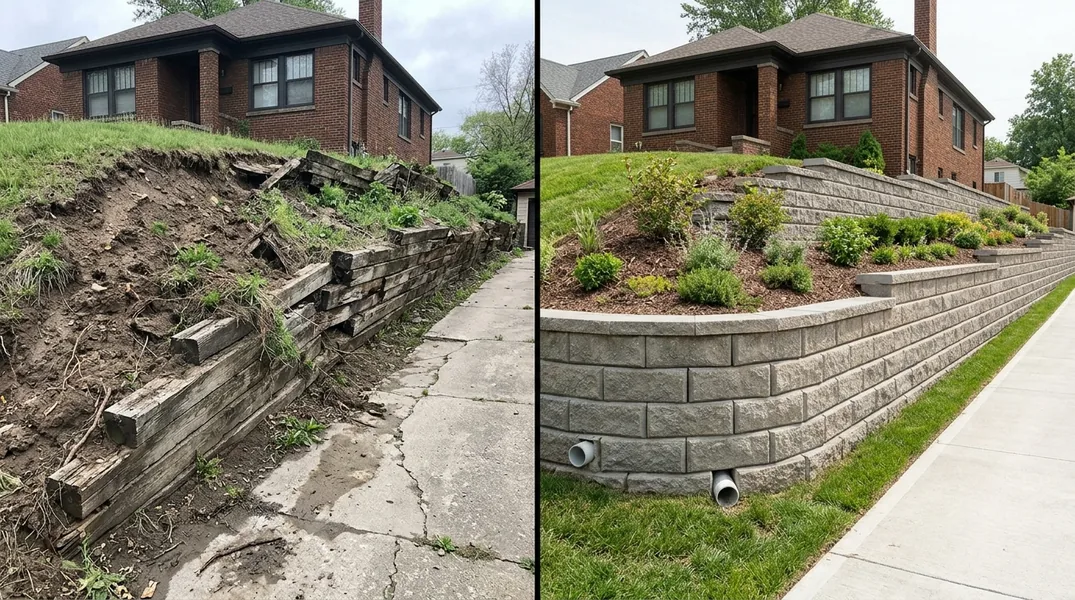
Understanding Detroit's Unique Soil Challenge
Detroit sits on some of the most challenging soil conditions in the Midwest. The region's heavy clay composition creates a perfect storm for retaining wall problems. Clay expands when wet and contracts when dry, a cycle that repeats seasonally and puts constant pressure on any structure holding it back. This freeze-thaw cycle is particularly brutal in Michigan winters, where moisture trapped in clay literally pushes outward with tremendous force.
Unlike sandy or well-draining soils, clay holds water like a sponge. When spring rains and snowmelt arrive, that moisture doesn't escape quickly. Instead, it saturates the soil behind your retaining wall, increasing hydrostatic pressure exponentially. A wall that was stable in summer can suddenly be under immense stress by late fall. Homeowners in Dearborn and surrounding areas have discovered this the hard way, watching their walls shift and fail after just a few years of what seemed like normal weather.
Why Retaining Walls Fail in Clay Soil
The primary culprit behind retaining wall failure in clay soil is inadequate drainage. When a wall is built without proper drainage systems, groundwater accumulates behind it. This trapped water creates lateral pressure that pushes against the wall structure. Over time, this constant pressure overcomes the wall's strength, causing it to tilt, bow, or eventually collapse. Many older retaining walls in Livonia and throughout the region were installed without modern drainage solutions, making them particularly vulnerable.
Poor compaction during installation is another common reason walls fail prematurely. If the soil behind the wall wasn't properly compacted during construction, it settles unevenly over time. This settlement creates voids and weak points where water can infiltrate more easily. Additionally, walls built without adequate reinforcement or on unstable foundations cannot withstand the forces that clay soil exerts. The combination of heavy clay, poor drainage, and inadequate construction is a recipe for structural failure.
Freeze-thaw cycles compound these problems significantly. Water trapped in clay freezes and expands, pushing the wall outward. When it thaws, the pressure temporarily releases, but the damage is already done. Repeat this cycle dozens of times over a few winters, and even a well-built wall can develop serious issues. This is why homeowners who ignore early warning signs often face catastrophic failure within just a few years.
Warning Signs Your Retaining Wall Is Failing
A Retaining Wall Repair is often necessary when you notice visible tilting or leaning. If the top of your wall is moving away from the soil it's supposed to hold back, that's a critical warning sign. You might also see horizontal cracks developing in the wall face, or notice that the wall is no longer vertical when you place a level against it. These signs indicate that the wall is already under significant stress and beginning to fail.
Water seepage is another red flag that demands immediate attention. If you see water dripping from the wall face or pooling at its base, your drainage system has failed. This moisture is the enemy, and its presence means pressure is building behind the wall. Bulging or bowing is perhaps the most obvious visual indicator of failure. When a wall bows outward, it's actively losing the battle against soil pressure. This is not a cosmetic issue; it's a structural emergency that requires professional intervention.
Soil erosion at the wall's base or top is also concerning. If you notice the ground settling away from the wall or small landslides of soil, the wall's foundation may be compromised. Additionally, if plants that were once thriving near the wall suddenly die, or if you notice new cracks in nearby patios or driveways, these could indicate foundation movement related to wall failure. Don't wait for multiple warning signs to appear before taking action. Any one of these indicators warrants a professional assessment.
How Professional Assessment Prevents Costly Failure
When you contact Detroit Retaining Wall at (313) 474-9126 for an evaluation, our team assesses the wall's structural integrity, soil conditions, and drainage effectiveness. We look for the specific ways clay soil is interacting with your wall and identify exactly what's causing any visible problems. This professional diagnosis is crucial because the solution depends entirely on understanding the root cause. A wall that's failing due to poor drainage requires a different fix than one failing due to inadequate reinforcement.
A thorough inspection includes checking for water saturation behind the wall, evaluating the wall's angle and alignment, examining the foundation, and assessing whether the wall was built to proper specifications for Detroit's soil conditions. We can often identify problems long before they become visible to the homeowner. Early detection means you have more repair options and can avoid the much higher cost of complete Retaining Wall Replacement. Many homeowners are surprised to learn that catching a problem early can cut repair costs in half.
Repair Solutions for Failing Walls in Clay Soil
The most effective repair for a failing retaining wall in clay soil typically involves installing or improving drainage systems. This might mean adding a perforated drain pipe behind the wall, installing a French drain system, or creating a proper drainage layer with gravel. By managing water, you eliminate the primary force causing failure. For Concrete Retaining Walls, we can also install drainage ports that allow water to escape rather than accumulate.
For walls that are actively leaning or bowing, reinforcement may be necessary. This could involve installing soil anchors, helical tiebacks, or adding structural support to the wall face. In some cases, a combination of drainage improvement and reinforcement provides the best long-term solution. The specific approach depends on the wall's construction material, the degree of failure, and soil conditions at your property.
When repair isn't feasible, Retaining Wall Installation of a new, properly engineered wall is the answer. Modern retaining walls are designed specifically for clay soil conditions. They include proper drainage systems from the start, are built on stable foundations, and use reinforcement appropriate for local soil conditions. While replacement is more expensive than repair, it provides a permanent solution and protects your property investment for decades to come.
Retaining Wall Repair Cost in Detroit: What to Budget
The cost of retaining wall repair varies significantly depending on the problem's severity and the solution required. A drainage system upgrade might cost between $1,500 and $5,000, while reinforcement work could range from $3,000 to $10,000 or more. Complete replacement typically runs $5,000 to $20,000 or higher, depending on the wall's length, height, and materials used. For accurate pricing specific to your situation, we recommend getting a professional assessment.
The investment in timely repair is almost always worthwhile when compared to the cost of failure. A wall that fails completely can damage your property's foundation, create liability issues, and require emergency demolition and reconstruction. Additionally, addressing problems early prevents them from worsening, which keeps costs down. Many homeowners find that spending $3,000 on drainage repairs now saves them $15,000 in replacement costs later. If you're concerned about your wall's condition, contact us for a free estimate and get a clear picture of what your repair or replacement will actually cost.
Looking for a professional retaining wall contractor in Detroit? Detroit Retaining Wall responds fast for all your retaining wall needs.
Get a Free QuoteOur services: Retaining Wall Installation · Retaining Wall Repair · Retaining Wall Replacement