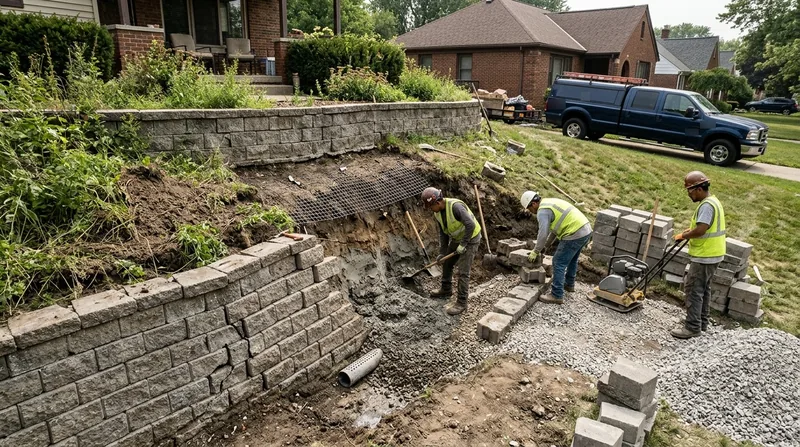




Detroit's retaining walls face relentless pressure from the region's dense, poorly drained clay soils and high water table, especially near the Detroit River and Rouge River ravines. When freeze-thaw cycles and spring saturation push a wall to lean, bulge, or collapse, the damage spreads fast. Leaning & Collapsed Wall Repair in Detroit demands immediate attention to prevent further settlement, property damage, and safety hazards. We respond with stabilization, drainage correction, and structural rebuilds tailored to Detroit's glacial lake plain terrain and the aging brick Tudors, bungalows, and ranch homes that depend on these walls to hold driveways, sunken patios, and riverbank grades. Call (313) 474-9126 for priority response, or visit our retaining wall repair page to learn more about our full repair scope.
Why Leaning and Collapsed Walls Happen Fast in Detroit
Detroit's flat glacial plain and heavy clay create ideal conditions for wall failure. Frost heave, poor drainage, and the weight of saturated soil after spring storms push walls outward and downward. A wall that leans 1 or 2 inches today can fail completely within weeks if the hydrostatic pressure and freeze-thaw stress are not relieved. Timber walls rot and lose strength, concrete cracks, and segmental block walls shift and separate. The longer a leaning wall sits, the more expensive and dangerous the repair becomes.
- Saturated clay and high water table near the Rouge and Clinton Rivers create constant hydrostatic pressure that pushes walls outward.
- Winter freeze-thaw cycles expand soil and ice, forcing walls to heave and tilt away from grade.
- Poor or blocked drainage allows water to pool behind the wall, doubling the load on the structure.
- Aging timber walls absorb moisture, rot from the base up, and lose bearing capacity in 15 to 25 years.
- Concrete and CMU walls crack under pressure and allow water infiltration that weakens mortar and rebar.
Early intervention prevents total collapse and keeps repair costs manageable.
Key info: In Palmer Woods, Sherwood Forest, and Rosedale Park, many 1920s brick Tudors and Colonials sit on properties with 3 to 5 foot grade changes. Leaning walls holding driveway ramps and sunken patios are common. The Michigan Department of Environment, Great Lakes, and Energy (EGLE) and local Detroit building departments require permits for walls above 4 feet or walls that support surcharges such as driveways. Check with your local jurisdiction before work begins. More details are available at Michigan EGLE.
How We Stabilize and Repair Leaning Walls in Detroit
Our approach depends on the wall's condition, material, and the cause of failure. We start with a site inspection to measure lean, check drainage, probe for rot or cracking, and assess soil pressure. For walls that can be saved, we install tieback anchors, improve drainage, and rebuild damaged sections. For walls beyond repair, we remove and rebuild from the footing up. Every job includes site-specific solutions tailored to Detroit's clay and water challenges.
- We assess the wall's lean angle, material condition, and the source of pressure (water, frost, surcharge).
- We install or improve drainage systems to relieve hydrostatic load and reduce frost heave risk.
- We anchor the wall with tieback anchors, soldier piles, or buttress walls to resist outward movement.
- We rebuild damaged or rotted sections with new concrete, block, or stone matched to the original material.
- We backfill with compacted gravel and perforated drain pipe to ensure long-term stability.
- We schedule follow-up inspections to confirm the wall has stabilized and drainage is working.
This phased method keeps your property safe while controlling costs.
Local example: A 1950s ranch in Livonia had a 4 foot concrete block wall holding a driveway ramp that leaned 3 inches outward. The soil behind the wall was saturated and the block was cracked. We installed a perforated drain line behind the wall, sealed the cracks with epoxy injection, and anchored the wall with two tieback anchors set 4 feet deep into stable soil. The wall stabilized within one week. Total cost was $4,200. See our drainage solutions for more on how water control prevents future failure.
Repair Methods and When to Use Each
| Approach | Description | Best for |
|---|---|---|
| Drainage Repair | Install or clear perforated drain pipe, add gravel backfill, and slope grade away from the wall to reduce water pressure. | Walls leaning due to saturation, frost heave, or blocked existing drains. Prevents future failure. |
| Tieback Anchors | Install steel rods or cables anchored deep into stable soil or bedrock, then tensioned to pull the wall back into plumb. | Walls leaning 2 to 4 inches with good material integrity. Stabilizes without full rebuild and works on concrete, block, and stone. |
| Partial Rebuild | Remove damaged or rotted sections, rebuild with new material matched to the original, and tie into the stable portions. | Timber walls with rot, concrete or block walls with severe cracks, or localized failure. Preserves the wall's overall structure. |
| Full Rebuild | Remove the entire wall to the footing, excavate and compact the base, install new drainage, and rebuild with concrete, block, or stone. | Walls past saving, severely tilted (over 4 inches), or with multiple material failures. Guarantees long-term stability. |
| Buttress or Counterfort | Build a reinforcing wall perpendicular to or behind the failing wall to resist outward pressure and distribute load. | Tall walls, walls supporting heavy surcharges (like multi-story structures), or where tieback anchors cannot be installed. |
Leaning & Collapsed Wall Repair Cost in Detroit: What to Expect
The cost of leaning and collapsed wall repair in Detroit ranges from $2,500 for drainage-only repairs to $8,000 to $15,000 for full rebuilds, depending on the wall's length, height, material, and the extent of damage. A 20 foot wall that needs tieback anchors and drainage typically runs $4,500 to $6,500. A 30 foot timber wall with rot that requires full replacement can exceed $12,000. The biggest cost drivers are wall length, the need for excavation and site access, whether the wall must support a structure or driveway (surcharge), and whether the repair can be done in phases or requires complete removal.
We always recommend getting two to three estimates before committing. This helps you compare methods, materials, and pricing. Some contractors may recommend anchoring when drainage would solve the problem; others may push for full rebuild when partial repair is enough. A detailed estimate should include a site sketch, the method chosen, the materials (concrete, block, stone, or timber), labor and equipment time, and any permits or inspections required. Visit our pricing page for more examples and what to expect at each service level.
Factors that increase cost include trees or structures near the wall (requires careful excavation), poor access (narrow driveways, steep grades), high groundwater (demands more robust drainage), and the need for engineered drawings (walls over 4 feet or supporting a surcharge). Timing also matters: spring and early summer are peak season in Detroit, so booking sooner often locks in better availability and may prevent further damage that compounds the bill.
Leaning & Collapsed Wall Repair Near Me: What Detroit Homeowners Should Know When Hiring
Finding a reliable contractor near Detroit for leaning wall repair means checking three core qualifications: licensing, insurance, and proven experience with Detroit's clay and water challenges. Many contractors can build new walls, but fewer understand the specific pressures and freeze-thaw cycles that fail walls here. Ask to see licenses from the State of Michigan, proof of general liability and workers compensation insurance, and references from recent repairs in your neighborhood or similar soil conditions.
Always request a detailed written estimate that breaks down labor, materials, equipment, and any permits. Ask whether the contractor has experience with tieback anchors, drainage systems, and partial rebuilds, or if they only do full replacements. Verify that they understand your local city or township building code, permit thresholds, and setback rules. In Detroit, Dearborn, Livonia, and other communities, walls above 4 feet or supporting a driveway often need a permit and may require engineered drawings. A good contractor will handle this or refer you to a professional engineer without hesitation.
Check references thoroughly, especially from jobs done in the last two to three years. Ask how the wall has performed since repair, whether drainage is still working, and if any follow-up maintenance was needed. Don't choose based on price alone. A $3,000 estimate that cuts corners on drainage or uses undersized anchors will fail again within a few years, costing you double. Get in touch with us at our contact page for a free estimate and a straightforward conversation about your wall's condition and your options.
Leaning & Collapsed Wall Repair in Detroit: Pricing Guide
| Service | Price | Details |
|---|---|---|
| Drainage repair and grading adjustment | Starting at $2,500 | Includes drain pipe installation, gravel backfill, and slope correction for walls leaning due to saturation or frost heave |
| Tieback anchor stabilization | Starting at $4,200 | Two to four anchors installed and tensioned, plus drainage work, for walls leaning 2 to 4 inches with sound material |
| Partial wall rebuild | Starting at $5,500 | Removal and replacement of damaged sections up to 15 feet long, matched material, new drainage, and compacted backfill included |
| Full wall rebuild | Starting at $8,000 | Complete removal, footing work, new wall construction in concrete or block, drainage system, and site restoration for 20 to 30 foot walls |
| Engineered design and permit support | On estimate | Required for walls over 4 feet or supporting surcharges; we coordinate with engineers and handle permit applications |
| Estimate and site visit | Free | Response within 24 hours at (313) 474-9126; no obligation to book after consultation and written estimate |
Indicative pricing, the exact cost depends on square footage, finish, and site access. Free personalized estimate within 24h at (313) 474-9126.


