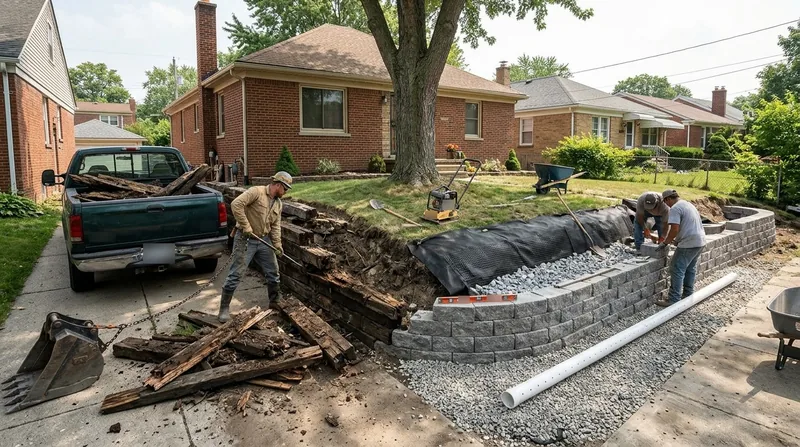




Railroad Tie Wall Replacement in Detroit means removing failed landscape timber and creosote-treated railroad tie walls from the 1970s, 80s, and 90s, then rebuilding them in modern materials that stand up to Detroit's freeze-thaw cycles, saturated clay, and high water table. Detroit sits on a flat glacial lake plain of dense, poorly drained clay where spring storms and winter frost heave push aging timber walls into failure. From Palmer Woods and Sherwood Forest to the brick bungalows of the east side and 1950s ranches in Livonia, Dearborn, and Troy, these old timber walls hold driveway ramps, sunken patios, raised beds, and ravine banks along the Rouge and Clinton rivers. When they lean, crack, or collapse, the damage spreads fast. We remove the old ties, haul away the creosote-treated material, install proper gravel backfill and drainage, and rebuild with segmental block, poured concrete, or natural stone that will handle decades of Michigan weather without rot or settlement.
Why Railroad Tie Wall Replacement Matters in Detroit's Freeze-Thaw Climate
Railroad ties and landscape timbers installed in Detroit 30 to 50 years ago were treated with creosote to resist decay, but creosote breaks down under UV light and freeze-thaw stress. Detroit's winters bring sustained cold, spring thaw brings water saturation in that dense glacial clay, and the cycle repeats year after year. The ties split, the wall leans inward or outward, and water pooling behind it accelerates the failure. A leaning timber wall is not a cosmetic problem. It signals foundation movement, drainage failure, and imminent collapse that can damage a driveway, patio, or nearby structure.
- We excavate and remove all creosote-treated ties and old backfill material to the footing depth.
- We haul away and dispose of the creosote material in compliance with Michigan waste regulations.
- We install 4 to 6 inches of clean gravel base and perforated drain tile to prevent water accumulation behind the new wall.
- We rebuild the wall in segmental block, poured concrete, or natural stone, set on a proper footing below the frost line.
- We backfill with drainage stone and compact in lifts to ensure stability and long-term performance.
A new wall eliminates the rot, settling, and water damage that plague timber, and gives you a structure that will hold for 30 years or more without maintenance.
Key info: Many Detroit neighborhoods, including Indian Village, Rosedale Park, and the brick bungalow districts on the east and west sides, have dozens of failing timber walls built in the 1970s and 80s. Frost heave and clay saturation are the dominant failure modes here, not erosion or tree root damage. A leaning or collapsed wall repair often requires full replacement rather than spot repairs.
For details on what permits may apply in your city, contact your local building department. Walls above roughly 4 feet measured from the footing, or walls supporting a driveway or structure, typically require a permit and possibly engineered drawings. Setback and property line rules vary by jurisdiction and must be verified before work begins.
How We Replace Railroad Tie Walls in Detroit: Process and Methods
The work begins with a site visit to assess the wall height, the extent of failure, soil conditions, drainage, and access. We determine whether the footing is below the frost line (critical in Michigan), measure the wall run and any grade changes, and identify utilities or nearby structures. We then quote the job based on material choice, wall height, and whether we need to shore up surrounding grade during demolition.
- We mark the work zone and protect adjacent landscaping, utilities, and structures with temporary fencing and tarps.
- We excavate behind the wall to expose all ties and remove them layer by layer, loading creosote material into separate waste containers.
- We remove old backfill and any deteriorated gravel down to the footing level.
- We set a new footing below the frost line (typically 3 to 4 feet deep in Detroit) or repair the existing footing if sound.
- We install perforated drain tile at the base and backfill with clean gravel in 6-inch lifts, compacting each lift.
- We build the new wall face in your choice of material, setting each course level and plumb.
- We backfill the full height with drainage stone, compact, and grade the surface to shed water away from the wall.
The entire process typically takes 3 to 7 days depending on wall length, height, and site conditions. We haul away all old material and leave the site clean and ready for landscaping or other work.
Local example: A 40-foot-long, 3-foot-tall timber wall in Dearborn holding a driveway ramp was leaning 2 inches into the grade after 35 years. The ties were split, water was pooling behind it, and the driveway was cracking. We removed the old ties, set a new concrete footing, and rebuilt in segmental block with a geogrid reinforcement. The new wall is plumb, drains properly, and the driveway settled back to grade within weeks. See our retaining wall replacement service for more examples.
| Approach | Description | Best for |
|---|---|---|
| Segmental Block (SRW) | Interlocking concrete units with geogrid reinforcement, no mortar, fast assembly, and proven durability in Michigan freeze-thaw. | Most residential jobs, driveway ramps, raised beds, and slopes up to 8 feet tall. |
| Poured Concrete | Monolithic reinforced concrete wall, custom height and finish, excellent for tight spaces and high loads. | Tall walls, heavy surcharge (driveway or structure), and sites where a single solid face is preferred. |
| Natural Stone (Boulder, Fieldstone) | Michigan fieldstone or glacial boulders, mortared or dry-stacked, blends with historic neighborhoods and ravine settings. | Heritage homes in Palmer Woods, Indian Village, and Grosse Pointe, Rouge or Clinton river banks, and aesthetic-focused projects. |
| Hybrid or Tiered | Combination of materials, e.g., stone veneer over block, or tiered walls with different materials at different heights. | Complex grade changes, sunken patios with multiple walls, or where visual variety matches the home's architecture. |
Railroad Tie Wall Replacement Cost in Detroit: What to Expect
Railroad tie wall replacement in Detroit starts at approximately $35 per square foot for a straightforward segmental block rebuild with standard backfill and drainage. The price moves up based on wall height, length, material choice, site access, soil conditions, and whether the existing footing is reusable or must be rebuilt. A 40-foot wall 4 feet tall (160 square feet) typically runs $5,600 to $8,000 depending on material and drainage complexity. Poured concrete and natural stone cost more upfront but last longer and often justify the investment in heritage homes or high-visibility locations.
Factors that affect the final price include the depth and condition of the existing footing, the water table and drainage requirements (critical in Detroit's clay), the distance from the street or staging area, whether utilities or trees require protection, and any grading or site prep needed before the wall build begins. A wall holding a driveway or supporting a structure may require engineered drawings and a permit, which adds time and cost but is necessary for safety and code compliance.
We recommend getting 2 to 3 written estimates from licensed contractors in your area. Each estimate should specify the material, wall height and length, footing depth, drainage details, and what is included in the price (haul-away of old material, site cleanup, permits). This comparison helps you understand the scope and spot any contractor who is underpricing or skipping critical steps like proper drainage or frost-line footings.
For a detailed breakdown of pricing by material and wall size, visit our full pricing overview. Call us at (313) 474-9126 for a free, no-obligation estimate on your specific project.
Railroad Tie Wall Replacement Near Me: What Detroit Homeowners Should Know When Hiring a Contractor
Hiring the right contractor for railroad tie wall replacement is as important as choosing the material. You are looking for someone licensed and insured in Michigan, experienced with Detroit's clay and freeze-thaw conditions, and willing to pull permits and work with your local building department. Ask for references from recent jobs in your neighborhood, and contact at least two of them to confirm the contractor finished on time, cleaned up properly, and the wall is still performing well.
Check whether your homeowners association or local historic district has rules about wall materials or appearance. Some Detroit neighborhoods, especially Palmer Woods, Sherwood Forest, and Indian Village, have design guidelines that may require natural stone, specific colors, or engineer approval. Verify these requirements before signing a contract. Your contractor should be familiar with local rules and able to guide you through the permit process if one is needed.
Always ask for proof of license, insurance, and a written contract that spells out the scope, timeline, materials, price, and warranty. A reputable contractor will stand behind their work for at least one year and will provide a certificate of insurance on request. Do not pay the full price upfront; a typical schedule is one-third down, one-third at 50 percent completion, and the final third upon completion and inspection.
For help finding the right contractor or to schedule a free estimate, contact Detroit Retaining Wall at (313) 474-9126.
Railroad Tie Wall Replacement in Detroit: Pricing Guide
| Service | Price | Details |
|---|---|---|
| Segmental Block Wall Replacement | Starting at $35/sq ft | Standard height up to 5 feet, includes footing, drainage, and compacted backfill with clean gravel material |
| Poured Concrete Wall Replacement | Starting at $45/sq ft | Reinforced concrete, custom height and finish, higher cost offset by durability and zero maintenance over decades |
| Natural Stone or Boulder Wall Replacement | Starting at $50/sq ft | Michigan fieldstone or glacial boulders, mortared or dry-stacked, premium material and labor for heritage and ravine sites |
| Complex or Tiered Wall Replacement | On estimate | Multiple materials, significant grade change, engineered drawings, or tall walls over 8 feet require site assessment before pricing |
| Travel and Site Prep | Included | No separate travel fee or mileage charge within Detroit and surrounding areas; site protection and temporary fencing included |
| Free Estimate | No obligation | Response within 24 hours at (313) 474-9126, includes site visit, measurements, material options, and written quote |
Indicative pricing, the exact cost depends on square footage, finish, and site access. Free personalized estimate within 24h at (313) 474-9126.


